Sunday, January 26, 2020

RTD: 5 Underrated Gems & 5 Biggest Disappointments


To kick off my Best of the Decade recap, I want to start with something a little small, five of the most underrated/overlooked gems and five of the biggest disappointments I experienced – nothing groundbreakingly amazing for the former (though there are some remarkable movies) and nothing earth-shatteringly awful for the latter, but movies I still couldn’t resist talking about. Also, for the disappointments, I want to make it clear that I don’t think any of these particular movies are bad – they’re simply movies that were dragged down by their inability to live up to their potential. Enough said – let’s get started!

5 UNDERRATED GEMS


BPM (BEATS PER MINUTE) (2017, dir. Robin Campillo)
Set in the early ‘90s, BPM recounts the Paris chapter of ACT UP, an activist collective working to combat the AIDS epidemic. Though ultimately a fictionalized account, director Robin Campillo injects his personal experiences of his involvement with ACT UP, and the film remains in my mind as an exceptional addition to the canon of LGBT cinema. Though there is no remarkable cinematography or any philosophical profoundness, BPM is a film powered purely by heart and soul, and it delivers. It is a political film, yes, but it is never once alienating, as BPM never forgets the human lives at hand, making for an experience that is thematically engaging and profoundly human for all of its 140 minutes, a feat indebted to the skills of actors Arnaud Valois and Nahuel Perez Biscayart, who take centerstage as a couple directly impacted by AIDS and the tragedy that ensues from it. Despite excellent reviews and a marvelous performance at Cannes (taking home the Grand Prix award), I’ve yet to hear anybody discuss BPM following its theatrical runs – for a film as assertive as this, with a great viewing experience to suit, BPM demands more attention.  


COLUMBUS (2017, dir. Kogonada)
Stuck in their own existential crossroads, two uncertain souls – the middle-aged son of a renowned architect (John Cho) and a high school senior with a passion for architecture (Haley Lu Richardson) – cross paths and form an unlikely bond in Columbus, the directorial debut from video essayist Kogonada. It’s a small, humble film that never reaches for the throat in the drama that carries throughout. Despite this, Columbus triumphs as a provocatively quiet experience, sometimes even tearjerking – the solid performances and fascinating chemistry between Cho and Richardson play a huge part in this, complimented by a moody score by Hammock, perfectly suiting the small scale of the film. What makes Columbus such a singular experience, however, is the gorgeous cinematography from Elisha Christian, who truly captures the jarring and awe-inspiring architecture of Columbus, Indiana, often considered the birthplace of modern architecture. Though Columbus is perhaps a bit too humble for its own good, I cannot deny that it is an effective indie film, and as far as I’m concerned, Kogonada is a name to be kept on every cinephile’s radar.


IN THE FAMILY (2011, dir. Patrick Wang)
In his 2011 debut In the Family, Patrick Wang writes, directs, and stars as Joey, who is in the midst of a complicated custody battle of his partner’s young son after the sudden death of the former. From my experience, movies that deal with progressive themes have a tendency to bank on said themes as the main feature, sometimes to the point of self-righteous smugness, rather than something circumstantial. Though Wang deals with a myriad of progressive themes here, he never calls attention to these issues – open, but not in-your-face, a truly refreshing change of pace in contrast to the trends I previously mentioned. And the actual film is truly something special. My only criticism is the bloated runtime (just shy of 3 hours), but within that timespan is a gripping courtroom drama (a setting I’m usually not a fan of), touchingly human thanks to phenomenal performances, especially from Wang – if I were to rank my top 10 favorite male performances from the last 10 years, Wang’s lead role here would earn a spot in the top 3. For such a talented auteur, it’s a shame Wang isn’t more well known, unfortunately further evident after the release of 2018’s A Bread Factory (which was Matt Zoller Seitz’s pick for that year’s best film). He may not be recognized, but at least he’s making movies. Here’s to hoping for more from Patrick Wang, because indie cinema needs more filmmakers like him.


JAMES WHITE (2015, dir. Josh Mond)
Fewer thoughts are more painful for me to dwell on than that of inevitably losing my mother, and very few films have been able to tap into those fears like James White did, and the lack of attention it gets baffles me (the only reason I know if it is a 4/4 rating on rogerebert.com). A terrific Christopher Abbott takes the lead as the titular protagonist, a man in his late-20s with no direction, no prospects, and no particular motivation to care. Soon, however, his life takes a sharp left turn when his mother (Cynthia Nixon) suddenly approaches her final days when she becomes terminally ill, and only James is in a place to take care of her, forcing him into a life-changing crossroads. Granted, all of the circumstantial elements of James White – cinematography, script, etc. – aren’t much to write home about, the proximity this film gets with its subject matter is almost literally too close for comfort. I wish you the best of luck not tearing up by its end, but as sad as James White is, it ends on an optimistic note. When it does end, you just might feel compelled to give your mother a call. For your and her sake, do that.


KRISHA (2015, dir. Trey Edward Shults)
Trey Edward Shults has been steadily rising as an auteur to be reckoned with (further solidified with the recent release  of the exceptional Waves), all of which has started with the 2015 release of Krisha. Set on Thanksgiving Day, the titular Krisha (Krisha Fairchild), a recovering alcoholic, comes to the family gathering to redeem herself, but tension gradually boils to discomforting degrees. Anybody who has ever had that family member and/or has been put in the midst of a similar situation, Krisha is so well done that you will have no choice but to relive that moment in your life. What’s truly remarkable about Krisha is how it thrives via its meager limits; it was shot over the course of only 9 days, with the cast made up of mostly friends and family of Shults, including Fairchild, Shults’ real-life aunt. Not once does a glimmer of amateur filmmaking glare, and Krisha becomes one of the most confident and assured debuts I’ve ever seen, and the lack of attention Krisha gets borders on criminal.


5 BIGGEST DISAPPOINTMENTS


BRAVE (2012, dir. Mark Andrews; Brenda Chapman; Steve Purcell)
Not many may expect this from me, but I have a huge soft spot for Celtic lore, especially all of the beautiful folk music that goes along with it (my mother and I were regulars at the annual Kansas City Irish Festival). Containing my excitement was difficult upon seeing the first trailer for Brave, the next Pixar film centered on ancient Celtic culture. My expectations were soaring in the heavens, but what I got was yet another “princess against traditional roles” story. I don’t mind a familiar story as long as something unique is done with it – other than the setting, it just felt stale and a touch tired, not to mentioned paired with a subplot involving a bear that was, frankly, just plain silly. It wasn’t a complete failure: the voice acting was solid (especially from Kelly Macdonald), and the climax was a terrific lesson that there is a time and place for diplomacy as well as for battle. Not a bad film, by any means, but a mediocre outing from Pixar as well as a major missed opportunity.


THE DISASTER ARTIST (2017, dir. James Franco)
There’s always been a magnetic enigma to The Room, the cult sensation dubbed “the Citizen Kane of bad movies”, and Greg Sestero’s book The Disaster Artist was something of a revelation. It was the Ed Wood of my generation, as well as perfect material for a film adaptation. James Franco must have felt the same, not only directing the film adaptation, but also starring as Tommy Wiseau. Despite James Franco’s surprisingly effective performance (I didn’t think anybody could capture Wiseau that well), The Disaster Artist minimizes the bizarre friendship of Sestero and Wiseau (the true heart of the story) in favor of uninspired hopping of one funny highlight to the next, often taking superficial jabs at Wiseau’s expense. Sure, the recreation of key scenes The Room are fun to watch (albeit feeling like plastic knock-offs), but once the novelty has worn off, there’s little to latch on to – this movie would be nothing of significance if not for The Room. There is at least passion behind Franco’s The Disaster Artist, but more often than not, it’s misdirected. In other words: the book was better.
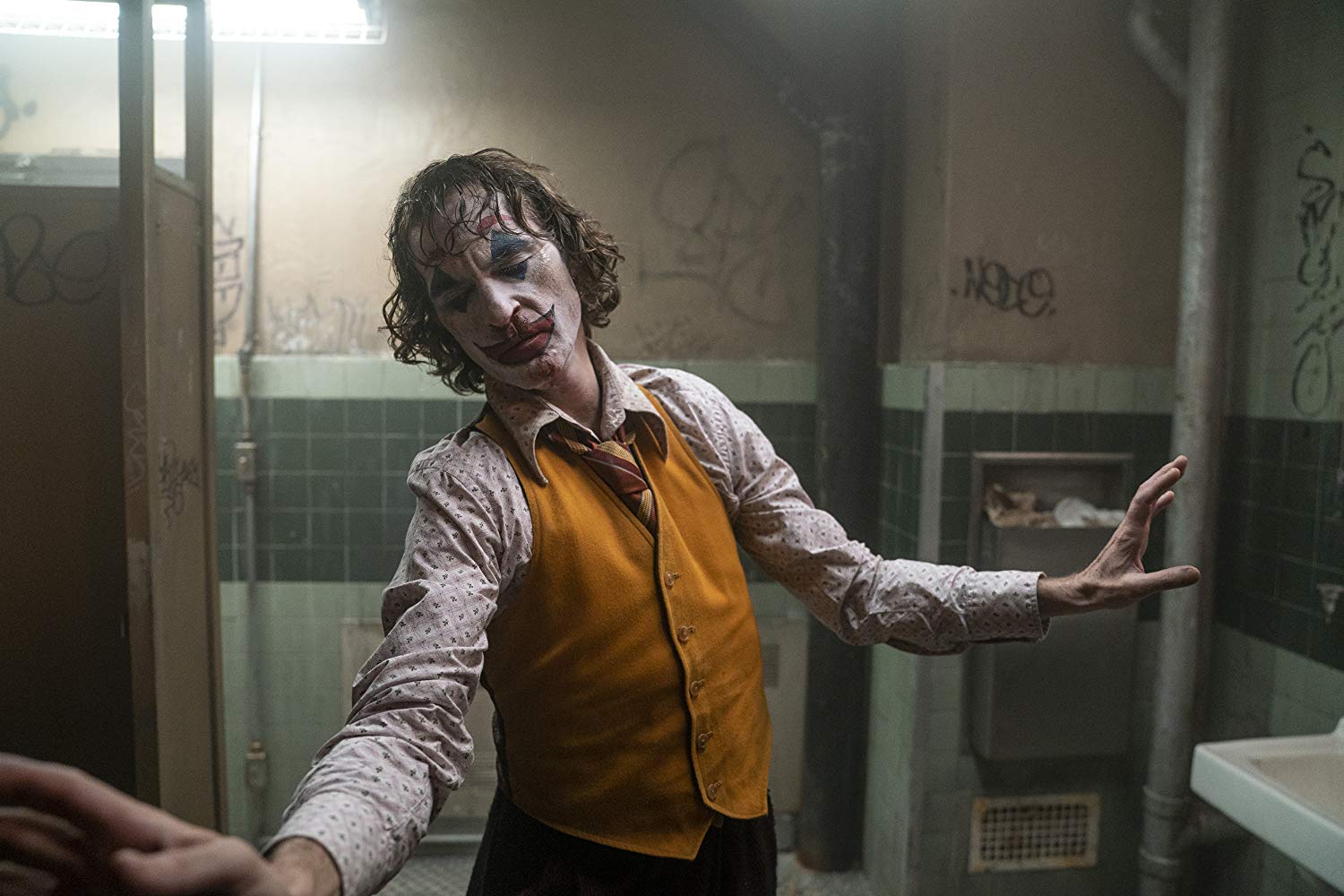


JOKER (2019, dir. Todd Phillips)
I may not be big on the whole comic book movie craze, but I must admit that I looked forward to Joker. A non-canon origin story dual-functioning as a stand-alone urban loner drama a la Taxi Driver was not only ripe for potential (further promised with a lead performance from Joaquin Phoenix, one of the best actors today), but a much-needed break from the standard issue comic book movie fare. It was certainly refreshing to see something different that took risks, but different and risky doesn’t make a good movie by default. Joker indeed talks the talk of Scorsese & Schrader, rich in atmosphere and palpable in its depiction of urban decay. When it attempts to walk the walk, though, it stumbles comically, often resembling the attitude a teenager who thinks being edgy is deep and profound by default. What a shame, because there are moments when Joker really, really tries, but its pseudo-deep attitude and bad choices leave the film horribly unbalanced. Not even Phoenix could save it – despite a committed performance, this Joker is a character that hasn’t been fleshed out enough to be worth such talent and commitment.


T2 TRAINSPOTTING (2017, dir. Danny Boyle)
Trainspotting was never a masterpiece for my taste, but it’s difficult not to be won over by its bizarrely memorable characters and the drug-fueled misadventures they get tangled in – they deserve to be revisited. Granted, a sequel already existed in the form of Irvine Welsh novel Porno, but Trainspotting’s morbidly beloved ensemble needed to be brought back to the screen. Well, 2017 saw the release of just that: T2 Trainspotting, set 20 years after the events of its predecessor. Admittedly, seeing the skagboys on screen brought a smile to my face, but it didn’t take too long before that smile was brought down by Boyle’s trademark over-stylization, a lackluster script, and some of the clunkiest pacing I’ve seen yet in a movie. Though Spud’s subplot about writing memoirs is very touching, none of the hijinks or stakes feel worth getting invested in, and the film ends up feeling like an aimlessly nostalgic dwell, despite the kinetic style and energy that power it. I equate T2 Trainspotting to eating a stale cupcake – no matter how sweet it is, no matter how much frosting or sprinkles top it, the dry, hardened basis makes for an unpleasant experience.


YOU WERE NEVER REALLY HERE (2017, dir. Lynne Ramsay)
We Need to Talk About Kevin was one of the best films I saw in the last 10 years. It firmly placed acclaimed Lynne Ramsay on my radar. Needless to say, I was psyched for her next film, whatever it may be. Well, circulating around the 2018 festival season was You Were Never Really Here, starring Joaquin Phoenix as a troubled war veteran who tracks and rescues missing girls. The praises and accolades were high, with one critic calling it “Taxi Driver for a new century.” To say I was excited was understatement, but when I finally got around to it, well…indifferent. Though Phoenix was absolutely terrific (in one of his most interesting roles), You Were Never Really Here feels detached from itself, never getting fully invested in its characters, story, or themes, despite such jarring subject matter. Other than a rescue sequence set to “Angel Baby”, there are no scenes worth talking about, and the entire film just comes and goes without much impact. These are all valid enough reasons to criticize a film, but the fact that I waited 6 years, but with the knowledge of the greatness Ramsay is capable of, You Were Never Really Here is disappointing in the coldest way possible.

Friday, January 24, 2020

EDITORIAL: Red Eye Recaps the Decade! 2010-2019


Good day, readers, and Happy (Belated) New Year!

It’s hard to believe such time has passed already, but there is no purpose in questioning it: here we are in 2020, at last. Not only a new year, but a new decade.  Before we settle into this new decade, I think it’s only appropriate to look back on the 2010s in movies, because to tell you all the truth: it was a great decade for movies.

Interesting that I say that, though, because I came into 2010 kind of worried about where film was going: the late 2000s further perpetuated the trend of overblown CG epic action flicks, a cycle attributed primarily to the 2009 release of Avatar, but also synonymous with the one-two punch of Iron Man and The Dark Knight in 2008, reviving comic book movies after dying for a while in the mid-to-late 90s. I don’t hate these movies, but for a while it felt like that’s all there was with no alternative. Even indie/arthouse cinema was stale at the time, stuffed with vapidly mundane films shot on handheld masquerading as “hyperrealism”.

I’m not sure what happened, but suddenly there were more solid movies being released rather consistently, and by the late 2010s, I couldn’t believe just how much great cinema was coming out, and how appropriate that 2019 was quite possibly the best year for movies this decade. Even movies that weren’t particularly great were at least interesting. Here’s what I have noticed, though: more risks from producers & distributors. It blows my mind that Paramount actually managed to get mother! and Annihilation major theatrical releases. And along with the riskiness from producers have been remarkable ambitions from independent filmmakers like Terrence Malick, who cinematically contemplated the entirety of existence in The Tree of Life, as well as Richard Linklater and his epic coming-of-age chronicle Boyhood

But the real heroes of the production/distribution side of movies are A24 and Neon Films, who frequently put out exceptional movies time and time again, and what a great domino effect: I can’t imagine how inspiring it must be for ambitious, aspiring young filmmakers realizing that there is, indeed, a market for their unique films, as well as producers willing to give them a chance. And who would’ve thought that Netflix, once a simple disc-mail rental service, have not only dominated the streaming market (something that admittedly has me nervous about the future of physical media), but continue to prove themselves as a powerhouse studio with masterworks like The Irishman and Roma.

The 2010s were certainly a great time to be a sci-fi fan, with some of the most remarkable movies this decade wisely taking notes from artful sci-fi of the ‘70s, the kind of films that deeply penetrate you consciousness and make you seriously contemplate life and the very world around you, something that’s been depressingly absent from sci-fi for so long. Two releases of this category in particular – Blade Runner 2049 and Mad Max: Fury Road – not only live as ultimate proof of the upward trajectory of sci-fi, but also proved what a sequel/reboot can be, no matter how belated or unnecessary it may be.

While we’re talking about genre films, I feel the 2020s are going to be a great time for horror, a genre that has failed to rise up to the bar set by its ‘70s golden age (with a few exceptions, of course). The former half of the 2010s saw the release of plenty of horror films that ultimately weren’t too special, but were at least trying. But then they started getting not only more interesting, but more terrifying. Then came Ari Aster in ’18 and ’19 with Hereditary and Midsommar, and I officially have faith that horror will see greatness before too long.

So, there’s my overall thoughts on the decade itself, but now I need to get into what this post is really all about. Throughout next week (starting Sunday), I will not only be counting down my top 30 favorite films of the decade, but also my 10 most honorable mentions, 10 most overrated, as well as 5 underrated gems & 5 biggest disappointments.

What are the qualifications? Simple: using IMDb as my primary source of dates, it can only be on the list if it premiered from 2010-2019, even if the wide release wasn’t until later. For example: Lee Chang-dong released a terrific faith drama called Secret Sunshine in 2007, but it didn’t see a wide release until 2010. In spite of its wide release in 2010, it still first premiered in 2007, so it won’t be making it on the list.

Before I let you go, I will be posting the schedule of entries below for your reference. See you on Sunday!

SUNDAY: 5 Underrated Gems & 5 Biggest Disappointments
MONDAY: Top 30: 30-21
TUESDAY: 10 Most Honorable Mentions
WEDNESDAY: Top 30: 20-11
THURSDAY: 10 Most Overrated
FRIDAY: Top 30: 10-1

Tuesday, December 24, 2019

FILM REVIEW: Uncut Gems (2019)


Directed by Ben & Joshua Safdie

* * * *

Howard Ratner, Adam Sandler’s character in Uncut Gems, dons something of a mask, one that doesn’t so much conceal his face as much as his person. It is a mask of glitz, characterized by gaudy eyeglasses and tacky jewelry including diamond earrings and gold necklaces. A pedestrian glance at him would allow dismissal as a shallow, materialistic showoff with nothing else going in his life. I don’t deny this as fact when discussing Howard, but look deeper into his face – his eyes are hollow and weary, revealing desperate exhaustion. His inner being pleads for a way out, but a lifetime of greed and fortune has permanently trapped him.

Howard is a jeweler in New York City, one with a gambling addiction that’s spiraling out of control, owing money apparently all over town (he cannot walk anywhere without being hounded by somebody about his dues). Life at home doesn’t bring him much rest – his wife (Idina Menzel) makes no secret of her hatred for him (his affair with a sexy coworker, played by Julia Fox, doesn’t help much). At this moment, though, Howard couldn’t care less; he has just received an uncut opal from Ethiopia, allegedly worth a million, which immediately catches the interest of Celtics basketball star Kevin Garnett, who convinces Howard to borrow it for tonight’s game as a good luck charm. What could possibly go wrong? Well…to say where it goes from there would simply spoil the experience, which would be nothing short of a crime.

Make no mistake, though; Howard’s dilemma is not likely to end well. It is a plight that tortures the viewer for over 2 hours, a depth-charge nosedive into a blackened pit that does have an end (one of rock bottom oblivion, no less), but the journey to that bottom stretches and spins to a dizzying, anxiety-inducing eternity. How will it all end? How out of control will it get? Despite an overall idea of the ultimate outcome, Uncut Gems keeps its viewers gripped hook, line, and sinker from start to finish, and the end result is one of 2019’s most memorable and intense films, as well as a startlingly profound study on the corruptive power of greed with an appropriate sense of humor peppered throughout.

Uncut Gems is the kind of film that never shuts up. Every minute, somebody needs to know where the money is, where somebody important is, where the jewelry is, and so on. The stakes are raised higher and higher, and the viewer is never allowed solace from the chaos. When the film quiets down, the trouble at hand never leaves the racing minds of Howard or the audience, and the immersion we get into Howard’s shoes is masterful – it’s the kind of movie that will demand a cigarette afterward. Don’t you dare take a break during the movie, though.

I’ve never been a big sports guy, and basketball plays a big part in Uncut Gems, but the method of incorporation is brilliantly played out. The film takes place in 2012, featuring actual games from that time. Those unfamiliar with those games will naturally be on edge, anticipating the outcome of the game itself. Basketball fans, knowing the outcome, will be left even more curious how Howard’s fortune will turn out. It’s one of the most genius uses of real events I’ve seen, and it’s perfectly encapsulated in the final act, which ironically turns the simple act of spectating into the tensest moment of the movie.

There was a trend in indie cinema some time ago, where all one had to do was shoot their film handheld and it was immediately indie/artsy/etc. It is a trend that got old really fast, but that doesn’t mean handheld can’t be utilized well. A perfect case study in that regard is Uncut Gems. Cinematographer Darius Khondji shoots the action in handheld, usually in very tight close-ups, and its powerfully stressful. When the camera goes wide, we get a pedestrian perspective that humiliates the characters, alongside a gritty depiction of New York that reminds us of the seedy underbelly that lies between the hip townhouses.

We’ve been ignoring the elephant in the room for far too long, the main reason to watch Uncut Gems: Adam Sandler. While dramatic territory is rare for Sandler, it is not new, but Uncut Gems has been getting particular praise in the case of Sandler’s performance. Believe the hype. Like Travis Bickle and Ratso Rizzo, Howard Ratner will be a gritty New Yorker known to movie lovers for years to come, and this is thanks to Sandler’s complete and total commitment to his performance, complimented by a refreshing sincerity: not once does this feel like a vanity project for Sandler. That said, while Sandler does take center-stage, the rest of the cast is exceptional. The wonderful resting bitch-face of Idina Menzel, the underrated Eric Bogosian as a loan shark, and Kevin Garnett as himself are especially deserving of recognition.

What a time we live in. By 2011, Sandler already had an awful reputation when he contaminated cinema with Jack and Jill, which has already gone down in history as one of the worst films of all time. Here we are in 2019, with only a week left of the decade, and one wouldn’t even fathom Sandler as capable of such garbage after witnessing this. Uncut Gems wisely avoids over-capitalizing on this rare gem in Sandler’s track record, but there’s a line seemingly directed at the Sandler-weary audience (curiously featured in the trailer) where Howard, begging for his wife’s forgiveness, utters the following sentence:

“Please…gimme another shot.”

Friday, November 8, 2019

FILM REVIEW: Doctor Sleep (2019)


Directed by Mike Flanagan

* *

For decades, there’s been a war over the superior vision of The Shining – Stephen King’s original novel vs. Stanley Kubrick’s iconic yet polarizing film adaptation. I side with the latter. The Shining is not only is it my favorite horror film by far, but it is one of the greatest films I’ve ever seen, and what made Kubrick’s film so fascinating and terrifying was its complete reworking of King’s novel into something more allegorical and elusive, rather than an air-tight paranormal story. I walked into Doctor Sleep knowing it could not hold up to Kubrick’s masterpiece, but the comparison can’t not be mentioned: this is acting as both a sequel to King’s novel as well as Kubrick’s film.

Rather than being a cynical cash-in on The Shining, Doctor Sleep is a sincere attempt at appeasing both the Kingians and Kubrickites with a clear passion for its source material. As admirable a move as this is, it is not a good one: the result is mangled by a story that is overwritten to the point of disinterest from the viewer, taking all of its substance down with it.

It is some 30 years after the events of The Shining. Dan Torrance (Ewan MacGregor), unable to shake the trauma from his childhood experiences, lives as a deadbeat and an alcoholic. He hits the road to a small town to start anew, where he gets sober. Over time, he forms a bond with young Abra (Kyleigh Curran), a psychic bond at that – she also shines, and communicates with Dan via chalk on a blackboard. Some years later, Abra’s communications become suddenly urgent – across the country is a cult known as the True Knot. They are caravanning across the States, feeding on “steam”, a sort of life essence from those that have the Shining. When their leader, Rose the Hat (Rebecca Ferguson), discovers Abra’s psychic meddling, she sets out to take the child down.

I won’t completely rule out the idea of a sequel to The Shining. Considering that child abuse is one of the many horrifying themes that can be mined from Kubrick’s film (see Collative Learning’s terrific analyses on YouTube), coping with that trauma into adulthood seems like the next logical step for the saga of Dan Torrance. Doctor Sleep’s opening moments are admittedly engaging, but once the story gets going, it becomes a muddled and convoluted mess that wants to be psychological terror, supernatural thriller, and deeply personal human drama all at once, but doesn’t know how to seam these tones together.

In addition to the unbearably rapid shifting of locations (one minute we’re in New Hampshire, next we’re in Iowa, etc.), pacing is handled poorly, with many key moments coming and going too quickly (little Danny’s resolution with the rotting corpse of Room 237 is laughably brief). I think this is more because of how overwritten the story is (one of Stephen King’s notable weaknesses): Doctor Sleep attempts to exhibit the capabilities of Shiners a bit more, but the results don’t feel completely fleshed out: they may seem like they have limitless powers until the plot requires them to have limitations. This lack of clarity with the Shining’s rules and limitations is only made more complicated with a new plot element, where the spirit of Dick Halloran teaches Dan to keep his haunting memories locked away in metaphysical boxes, which becomes a major plot point later on. It’s all headache-inducing.

Then there’s our characters. Though Dan is supposed to be our protagonist, played by a slightly bored Ewan MacGregor, Doctor Sleep really belongs to Abra, who emerges as the most compelling character in the story, played wonderfully by Kyleigh Curran – while her acting style feels out-of-place for this kind of story, there is still great talent on display. But then there’s the villainous True Knot, who, at best, have no menacing presence and are vapidly uninteresting. At worst, they’re kind of goofy, especially leader Rose, who resembles Diane Keaton if she were a New Age gypsy.

Despite these circumstances, there are some well-constructed sequences that don’t necessarily make the entire experience worthwhile, but are noteworthy. There are a few genuinely bone-chilling moments, one in particular involving a Little League Baseball player’s fate in the hands of the True Knot. The psychic duels between Rose and Abra are admittedly really cool and creatively executed, particularly one moment set in a supermarket.

But to top everything off, there’s the climactic showdown at the Overlook Hotel. Complimented by a meticulously crafted set design, it is now closed, boarded-up, and dilapidated – perhaps I shouldn’t be talking about this, but it’s shown in all the advertising. I think this whole sequence showcases the best aspect of Doctor Sleep: there’s a passionate sincerity for the source material that shines brightly through the entire film. Yes, there is fan service, but it’s in reasonable doses and never overshadows the main substance at hand, no matter how weak it is. At least Flanagan has his priorities straight.

There’s actually a lot more to Doctor Sleep that I’ve not even touched, but I honestly don’t care – the more the film went on, the more discombobulated it became, and the more detached I was. Considering the film was two and a half hours long, I definitely lost almost all interest. What a shame. There’s subject matter that is ripe with potential for a great horror film, and continuing Kubrick’s approach could have made Doctor Sleep interesting, but by simultaneously committing to King’s novel, it becomes an awkward experience that never reaches take-off speed due to frantic gear-shifting, confusing enough for fans of Kubrick’s film and even more so for fans of King’s novels.

Thursday, November 7, 2019

FILM REVIEW: Parasite (2019)


Directed by Bong Joon-ho

* * * *

I’m having trouble coming up with an opening paragraph for my review of Parasite, Bong Joon-ho’s universally acclaimed satire on class. There’s an element of it that is simply beyond description, despite Parasite being quite accessible – it’s simply one of those movies best discovered on your own, and is best walked into knowing as little as possible. But, if you’re reading this, you want to know what I have to say: Bong Joon-ho has a remarkable track record in his career, and Parasite is no exception. While I don’t think it’s going to live on as one of the all-time great Korean films, I can’t think of a bad thing to say about it. You can clearly see that 4/4 rating above, and if you can take my word for it, stop reading here and go see it. It’s good. Damn good.


From here on out, I’m doing my absolute best to avoid spoilers, but proceed at your own risk.

We are introduced to the Kim family, and there’s no other way to put it: they are dirt poor. Without a pot to piss in or a window to throw it out, they spend their days attempting to construct pizza boxes (1 out of 4 boxes are unusable) and opening their windows for free bug extermination when the fumigators roll into the neighborhood. A light shines at the end of this impoverished tunnel, though: son Ki-woo (Choi Woo-sik) is offered a job to teach English to the daughter of the Parks, a family so rich they probably don’t even know what to do with their money. Despite having no credentials, he is hired and accepted into the Park home, where he sees the perfect job opportunity for his art-inclined sister (Park So-dam). Before too long, the entire Kim family is working at this house (albeit, fraudulently), serving as the laborious backbone of the Parks.

I cease my plot synopsis here. I feel to say any more would result in some kind of criminal prosecution, because the yarn-ball that is Parasite unspools from one of the best scripts in a while. The Kim family is easy to warm up to, and the urgency of their poverty grabs your attention. With this, seeing them gradually shift from poverty to prosperity wonderful unto itself, but also darkly thrilling as they cleverly integrate themselves into the Park’s work force, pulling off one of the most memorable cons in 21st Century Cinema.

By all means, Parasite tells the kind of story that should agonizingly test (if not shatter) one’s verisimilitude, with all of the twists and turns it takes throughout. Amazingly, this never happens: no matter how wild or unrealistic a certain idea may seem, Parasite brilliantly rebounds into the realm of reality and possibility. For instance, without spoiling too much, a major twist occurs when things go…under, so to speak (you’ll know what I’m talking about once you see the film). Just when the movie was escaping believability, a quick explanation was given – rather than feeling like a hand-wave, it made complete sense.

Bong Joon-ho’s direction certainly plays a huge part in Parasite’s ultimate effect. It’s exciting upon the start, and the film becomes more and more gnarled as it goes on, resulting in a climax that goes completely off the rails. There’s major risk of things getting too out of hand, but Bong keeps everything in check the entire film – pacing is always consistent, shifts in tone are always warranted, and the film never bites off more than it could chew.

But I think what I admire most is the treatment of the two families. The subject of class in Parasite has been brought up for every discussion on the film. Considering this day in age, I feared that this would be a one dimensional “evil rich vs. misunderstood but gold-hearted poor” nonsense. To my surprise (and relief), this was not the case. Yes, the Parks (the rich) aren’t depicted in the most flattering light, but they’re not bad people – they’re just well-intentioned people whose naivete has become more prominent with their riches. As for the Kims, though they’re poor with almost nothing left to lose: considering that the family is pulling off one hell of a con job, the film never gives them license to get away with whatever they want beyond that (for the most part, anyway). You ultimately root for the Kims, but nobody becomes your object of hatred or intense condescension.

Parasite took home the Palme d’Or at Cannes 2019. I must admit that I am not convinced of this level of greatness – along with a lack of prominent or singular style, I feel the commentary on class tends to take a backseat to the incredible story, instead of the commentary emerging from the substance, though this will differ from viewer to viewer. It doesn’t quite transcend for me, but speaking on its own merits, I can’t say a bad thing about it. It accomplishes everything it set out to become without a single point of significant fault. I may see myself moving on from Parasite in a few months or so, but I definitely won’t forget it.

Friday, October 25, 2019

FILM REVIEW: The Lighthouse (2019)


Directed by Robert Eggers

* * * *

I saw The Lighthouse at my local mall, which has a long staircase leading up to the theater. Two hours later, I walked out of the theater after it was over, my mind steadily piecing itself back together. I was still in this dazed state when I approached the stairwell, demanding my descent to return home. I exaggerate not when I tell you that I stumbled those first few steps, nearly keeling over a few times. When I finished my descent (unharmed), it was then that I realized the excellence of The Lighthouse: it alone had taken a physical toll on me, and I cannot give a higher compliment.

From the dense fog of the sea arrives Ephraim (Robert Pattinson) and Thomas (Willem Dafoe), the next two wickies to tend to the lighthouse for the next four weeks. Ephraim is new to the job, a quiet man with a mysterious past, and he will be supervised by Thomas, the rambunctious veteran with a penchant for vulgarity, heavy drinking, and seaside superstition. He aggressively guards lamp duties, leaving the back-breaking manual labor to Ephraim. It’s grueling for Ephraim, but those four weeks go by with some tension, but was overall relatively painless, but things take a scary turn at the end of those four weeks: their replacements never show up. With no outside contact and a big storm brewing, the tightrope begins dangerously tightening on a mutually dependent yet strained relationship.

The Lighthouse is the second feature from Robert Eggers, and this is no sophomore slump. As evident in his previous feature, The Witch, Eggers clearly has a passion for the history of New England, which carries over to The Lighthouse. We are not given a specific year that the film takes place, but every aspect of the terrific production design tells us what time period this takes place in – without leaving the confines of the lighthouse, mind you.

The Lighthouse traps the viewer into its world. Its setting is so precisely imagined that it becomes nothing short of palpable, so much so that we can practically smell this place, let alone feel the grit and grime that encapsulates it, but a solitary setting with only two characters is a risky move for a filmmaker. Luckily, The Lighthouse is perfectly paced. Yes, the burn is slow – real slow – but just when the film begins losing your attention, it knows precisely when to make its next move and re-engage you.

Over time, we can even feel the walls closing in tighter and tighter, and that's due in great part to the film's narrow aspect ratio. The film appears disturbingly narrow up there on the movie screen, creating a boxy look. As ugly as it may be to endure the film, it is gorgeous to look at. With its photography and lighting, The Lighthouse creates a beautifully bleak palette of grey shades. While black & white has become a cliché in the independent film scene, this is undoubtedly one of the best-looking movies of the year.

But a key to The Lighthouse's madness is its sound design. Whether it be water dripping, a seagull chirping, or the lighthouse's ominous siren, film is never quiet as those very sounds drone on and on and on. Loud enough that they irk you, maybe even instigating an eye twitch here and there, but the sounds never call too much attention to themselves.

Much has been said about Dafoe and Pattinson, the very anchors of The Lighthouse. Believe the hype. While complimenting each other in their stark contrasts of personality (they know exactly how to push each other’s buttons), the two truly transform themselves into unhinged wickies of historical New England, adding to the film’s authenticity. Pattinson continues a promising ascension from his embarrassing start with Twilight to that of a prominent and respectable actor, but the stealing the spotlight is Dafoe, in perhaps his best performance since The Last Temptation of Christ. I was worried that the film might go too far with his crudeness, but Dafoe toes the line perfectly, always respecting exactly what kind of film this is.

The Lighthouse’s scenario with the personality of its characters make the film work well enough on a surface level, but there’s enough vagueness that it is indeed the kind of movie that rewards application of a deeper meaning to it. I admit that I’m still wrapping my head around the film, let alone figuring out what it meant to me, but it’s the kind of wonderful art movie that can be interpreted in countless different ways: existential pessimism? Political allegory? Two generations at war with each other? The possibilities are truly endless, and I expect a flood of analysis videos on YouTube upon the film’s home video release. Refreshingly, though, The Lighthouse is never on the nose or overbearing with whatever meaning may or may not live within – the fact that I’m still juggling what it may have all meant says a lot.

I cannot think of a more agonizing wait I’ve endured for a movie than The Lighthouse. The gritty black and white, the hauntingly beautiful photography, the solitary setting with a minimal cast, and the symbolic potential of a lighthouse gave promise for the exact kind of arthouse movie experience I long for, so much so that I became all the more paranoid that the movie would be ruined due to my own high expectations. Well, the wait is over, and The Lighthouse still came out swinging as a cinematic experience of the purest sense, utilizing every element the form has to offer. What we got from that is a true original that will go down as one of the year’s best and most memorable films.

Friday, October 4, 2019

FILM REVIEW: Joker (2019)


Directed by Todd Phillips

* * ½

Perhaps Joker will be the most polarizing movie of 2019, with reviews either being completely in its favor or against it – I’m not sure I’ve seen any middle-ground reviews yet. For me, it is neither masterfully good nor glaringly bad, and it’s especially frustrating in the case of Joker because there are a number of ideas that are brilliant if implemented well. When the film works, it is an atmospheric and truly captivating slow burn of one man’s boiling descent into madness in a world gone down the drain. When the film doesn’t work, though, it is misdirected and forced social commentary that is just a tad too proud of itself.

“Is it just me, or is it getting crazier out there?” asks the troubled Arthur Fleck (Joaquin Phoenix) to his psychiatrist, and indeed these are tough times Gotham City – the city is buried in filth as a result of an ongoing garbage strike as it approaches a tense mayoral election. During the day, Fleck commutes as a clown-for-hire, attempting everything in his power to bring laughter and joy to those around him, only to be shunned and heckled. At home, he cares for his ailing and unstable mother (Frances Conroy), taking solace in TV talk show hosted by comedian Murray Franklin (Robert De Niro). Fleck reaches his boiling point after a bad day when he is attacked by three yuppies on a subway – the result is three young men killed by a man in clown makeup. However, Fleck sparks an uprising amongst the economically downtrodden – the clowns – further fueling the ticking time bomb that is Gotham City. For Fleck, who is now a hero to some, this proves to be an opportunity to bring meaning and purpose into his tragic life.

Though I’m not a big comic book enthusiast, I’ve always been partial to the Batman franchise. With Joker, I feel like I got the best of both worlds. Allow me to expand: the film confidently walks the line between a self-contained psychological drama and a supervillain origin story. Joker never crosses this line, albeit with maybe one or two exceptions when the film ties into the rest of the Batman mythos, which I personally liked. Other than those select moments, Joker can be appreciated just as well as a portrayal of psychological breakdown and urban decay, reminiscent of the likes of Taxi Driver.

Joker is rich in atmosphere. With the sidewalks littered with garbage bags, the walls plastered with graffiti and worn & torn flyers, and the manhole covers emitting a steady flow of noxious steam, the smells and textures of Gotham City become palpable for the viewer. This rotting corpse of a city is further complimented by Hildur Guonadottir’s score. Though the dramatic underscoring at climactic moments is mood-killing, the music is otherwise reminiscent of the apocalyptic strings and death-march percussion of Godspeed You! Black Emperor, further adding to Gotham’s tragedy.

At the core of Joker is none other than Joaquin Phoenix, who has steadily emerged as one of the very best actors working today. Channeling sympathetic awkwardness, Phoenix carries the entire weight of the film and gives the role his all. Though Joker is undoubtedly going to be an iconic addition to his track record, I wouldn’t go so far to say this is one of his best roles. There are some overbearingly hammy moments, but I credit this less to Phoenix than the direction. There were some bad choices on the part of director Phillips, frequently overplaying Fleck’s uncontrollable laughter and strange dances, moments that could have worked if not done to death.

I wish my criticisms ended there, but we’re just getting started. Joker is simultaneously overwritten and underdeveloped. Though the main circumstance for Fleck’s ultimate descent is his own mental instability, there are a series of extenuating circumstances that amplify his outrage: his alienation from his workplace, his mother’s mental instability, his aspirations to be a stand-up comedian, his infatuation with a neighboring single mother, being humiliated on TV by Murray Franklin, and so on. This is already more than enough, but it’s even more irritating that none of these subplots are fully developed and are just kind of thrown into the mix, feeling more like padding than anything else.

Some elements of Joker I can only describe as irresponsible, it’s first offense being its attempts at comic relief. While Joker is more concerned with being a drama, it can’t resist pandering to audiences. Comic relief is one thing, but to not only be so tonally out-of-place with it, doing it so distastefully is unforgivable – keep an eye out for a scene involving two former coworkers visiting a completely unhinged Fleck late in the film. I was aghast in just how inappropriate this was.

And then there’s the climax, where Joker is not only laughably self-congratulating and forceful in its commentary (complete with a “We life in a society” speech) but the film begins to treat Fletch more as a hero rather than an unhinged loner. There’s nothing wrong with depicting bad people in a sympathetic light, but it is important to keep a healthy arm’s distance. Joker depicts the election subplot in an us vs. them light (the politicians aren’t exactly sweethearts in this film), and to see Fletch rise up as the face of resistance against these allegedly heartless politicians comes off as very irresponsible and, frankly, kind of disconcerting (the current political climate makes this ring a lot louder).

I’m torn between Joker. There were brilliant ideas and the execution was solid, but what I didn’t like glared so brightly I can’t completely approve of the overall movie, but there was very little I outright hated, so I don’t completely disapprove the film either. Regardless, in an era bloated with comic book films featuring clear-cut heroes & villains, to so closely examine, scrutinize, and understand the human being behind one of those villains is an audacious move. For that, I greatly respect Joker.

ADDED TO 'GREATEST FAVORITES': Akira (1988)

Directed by Katsuhiro Otomo “Neo Tokyo is about to explode.” So boasts the famous tagline for Akira , and it couldn’t be more ...