Wednesday, March 21, 2018

FILM REVIEW: Mary and the Witch's Flower (2017)

Directed by Hiromasa Yonebayashi

* * 1/2


The seminal and beloved animation Studio Ghibli is on a temporary hiatus. Fans may be discouraged, but Ghibli’s legacy is one that will never die – such is evident in Mary and the Witch’s Flower, the first feature from Studio Ponoc (founded by Yoshiaki Nishimura, Ghibli’s former lead producer). There are enough traces and echoes of Ghibli that run through this new film to keep fans satisfied, but perhaps that’s why it never transcended for me, as Mary and the Witch’s Flower is a little too focused on trying to be a Ghibli film that it lacks a unique identity. 

Based on The Little Broomstick by Mary Stewart, Mary and the Witch’s Flower tells the story of young Mary Smith, who is living with her Great Aunt Charlotte in the countryside. When we first meet Mary, she is frustrated with boredom. But she must continue on through her day, something that doesn’t bring her much joy either as she’s quite a klutz – she can’t get her hair to straighten out, she accidentally breaks a flower in her neighbor’s coveted garden, as well as humiliating herself in front of Peter, a boy from the neighborhood.

A pair of cats lead Mary into the woods, where she discovers a most unusual flower. Before she even knows it, she is granted powers; a hyperactive broom takes her (as well as one of the cats) to Endor College, a magic school for wizards and witches. There, she meets Madam Mumblechook, essentially the headmaster of school, as well as Dr. Dee, the lead scientist. They are both in awe of Mary’s apparent power, but she is completely oblivious to what’s going on and just improvising as she goes (she would be transformed as punishment for trespassing). At one point, Mary mentions the strange flowers, and Madam suddenly takes a threatening interest in Mary, as the flowers in question were stolen from her long ago. The flowers are revealed to contain great power, and Madam will do whatever it takes to get them back.

I don’t mind overdone stories or themes. I really don’t. It all depends on what you do with the material. Along with the tropes mentioned above, Mary and the Witch’s Flower is about growing and persevering as a person by trial through a snafu of a situation in incomprehensible territory. Once again, done before time and again, but I’m open-minded; just do something unique with what you’ve got, and this film doesn’t really do anything new. Most everything, if not everything, I saw in Mary and the Witch’s Flower I feel I’ve already seen in plenty of other Japanimation films: the lush green landscapes of the real world, the whimsical fantasy realm among the clouds and blue skies, a little bit of steampunk here and there…oh, can’t forget an adorable cat as a companion. Sound familiar yet?

If there was one issue with the movie that’s really worth getting into, it’s the character of Peter. For whatever reason, Mary absolutely does not like him. Okay, he teases her early in the film, but it’s just a brief little tease – the kind we all experienced as kids. But then he pretty much disappears from the movie and we forget about him for the most part. That is until he is trapped in a tricky situation, and only Mary can break him out. Considering she doesn’t like him, it’s a big deal for her to have to save him, but because of the lack of development between the two, there’s no weight to the scenario, nor in the resolution.

Granted, it’s not a bad film by any means. Mary’s clumsiness was always cute. Madam Mumblechook and Dr. Dee were always a ton of fun (probably the best part of the movie, now that I think about it). There’s an interesting twist involving Great Aunt Charlotte. Oh, and the broom was awesome! Like the magic carpet in Aladdin, Little Broom (that’s the name Mary gives it) has personality, in spite of being a simple object.

Yeah, these are good things I’m saying about the film, but I mention them more or less for the sake of a balanced review. It’s kind of disingenuous to say that it’s “not a bad film” without pointing out the things I liked in the movie, because there were things I liked. Just not enough to warrant any kind of significant praise.

The characters were fine. The animation was fine. The story was fine. The music is fine. It moved along just fine. Mary and the Witch’s Flower was just fine, and I really can’t say much more than that. While everything was enjoyable and there were no glaring issues, nothing really sticks out. Will Mary and the Witch’s Flower be a waste of time and money? Absolutely not, but it’s not going to be the almost metaphysically powerful experience that films like My Neighbor Totoro, Princess Mononoke, and Spirited Away seem to be (with the exception of Totoro, I was never a big Miyazaki fan). I will not discourage you from Mary and the Witch’s Flower, nor is there any reason to, but you won’t be missing anything if you pass on it.


Sunday, March 18, 2018

FILM REVIEW: I Can Only Imagine (2018)

Directed by Andrew & Jon Erwin

* * 1/2


MercyMe’s hit single “I Can Only Imagine” has inspired countless listeners for almost two decades. Subsequently, it is the number 1 Christian song in America There’s that saying “a blessing in disguise”, which applies perfectly to the scenario, as this seminal song was the product of years of abuse and despondence from frontman Bart Millard’s father. This new film, bearing the same name as the song, tells the story of how Millard’s ballad came to be an anthem among listeners. I highly doubt this movie will gain MercyMe any new fans or inspire any religious conversions, it at least possesses a heartbeat that keeps flowing what power the film does have.

Bart Millard (J. Michael Finley) grew up in an abusive household, the perpetrator being his father Arthur (Dennis Quaid). In between the violent blows and arguments between his parents (his mother would eventually leave), Millard finds solace in music – his Walkman and headphones seem almost inseparable from his being. In high school, he is discovered to have an exceptional talent in singing. After graduating, he forms a band and they hit the road with a mission to make it big time. From there, the rest is Christian rock history, but the path to making such history doesn’t go without Millard’s inner struggles, unable to cope with his traumatic childhood, but the band manager Scott (Trace Adkins) has a word of advice - channel that pain into his art.

Filmmakers, take note: a great film knows when to walk, when to tip-toe, when to stop, and when to run. I assure you that people are willing to sit through good movies, no matter how lengthy they might be.

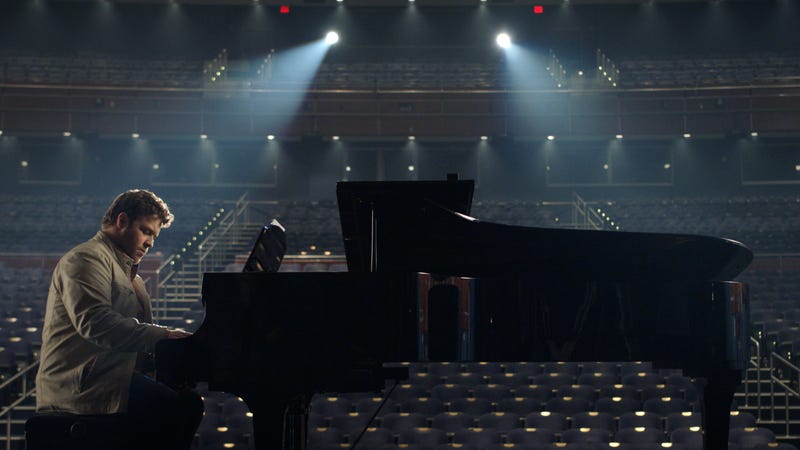
There is a scene fairly early in the film when Millard is assigned as assistant sound director for his school’s chorus. He goes into the empty auditorium, dusts off the equipment, and gets giddy when he lays his eyes upon the tape deck. He inserts one of his cassettes and begins jamming. Here is a moment that potentially shows just how much music means to Millard, but before we get a chance to really take things in, his teacher interrupts his private jam session and next thing you know, the next scene is already here.

These pacing issues persist throughout I Can Only Imagine, which robs the film of any chance it might have had to become a touching and moving drama about faith, redemption, and the power of music. Speaking of these issues, here is the other big problem with the movie. Perhaps it was tackling more than it could handle, but it has a lot of trouble balancing its themes. One moment, it wants to be a story of the uplifting power of music, next it wants to be about the power of faith (for the record, this is not a pious film), and then it wants to be a story of redemption.

Though the redemption aspect seems to be the biggest focus (more on that later), the faith and music aspects are just kind of…there. The film never really delves into how Millard became a man of faith (let alone a man of as intense faith as he is). Sure, he went to a week-long bible camp early in the movie, but the setting serves more as a backdrop for the start of Millard’s relationship with now-wife Shannon (Madeline Carroll) instead of Millard’s foray into Christianity. The same goes for his passion for music; the film never really talks exactly about what artists meant a lot to him in his formative years (save for Amy Grant). The only effort the movie puts into the importance of music is simply putting a pair of headphones on Millard’s ears and filling his hands with a Walkman and a couple of cassettes.

While the overall film may not be the most moving of dramas, it doesn’t go without some touching moments here and there. In the road leading to the film’s final stretch, Millard returns home to confront his father, who he has discovered has turned his life around for Christ. Though the pacing is still a bit shaky, here is where the film is at its most powerful just because it realizes that it must slow the pace down, as well as cut out the sappy music cues and editing techniques – the film just sits back and lets the drama unfold exactly how it should (if only they’d ditch the tacky set design).

At least the performances are good. J. Michael Finley approaches the lead role with a humble everydayness, making the character enjoyable and quite likeable. You grow to really care about Millard through his struggles. Trace Adkins is wonderful as a dry comic relief. Dennis Quaid, however, is a mixed bag: when he’s an abusive tyrant, his performance is not only cliché but also kind of silly. When he’s stricken with sadness and regret in the film’s later moments, he’s actually quite good. Unfortunately, there’s too much of the former, and it takes a long time before we get to enjoy the latter.

As many criticisms as I give, I Can Only Imagine still has heart and passion in all the right places, and I don’t dare fault it for that. Non-fans of MercyMe (Christian music in general, for that matter) can sit I Can Only Imagine out without missing a thing – I certainly wouldn’t have, but I didn’t mind watching it. As for fans and the faithful – you won’t be getting the best musician biopic or most powerful testament to faith through this movie, but it can make a decent afternoon Sunday outing for youth group.


FILM REVIEW: 7 Days in Entebbe (2018)

Directed by Josa Padilha

* *


Personally, I like transgression. I like seeing angles not usually explored in art, movies especially – everyone has a story after all. If anything, take me to a place I don’t want to go. As difficult as it may be to sit through, your point will probably get across a lot better. But for a film to humanize revolutionary terrorists in a Post-9/11 world is a very risky move, and this is an element of 7 Days in Entebbe. I applaud the courage, and I am perfectly willing to see this angle, but the film must deliver. Ultimately, 7 Days in Entebbe didn’t. On top of being unfocused, it is also just plain dull, and a riveting story like the Air France hijacking of 1976 isn’t deserving of such mediocrity.

History lesson time: in 1976, four revolutionaries – two Palestinian, two German – hijacked Air France Flight 139. They stopped in Entebbe International Airport, holding 248 civilians hostage. On behalf of a political/ideological agenda from Palestine, the terrorists demand $5 million, as well as the release of Palestinian militants currently imprisoned in Israel.

There are two central parties in 7 Days in Entebbe that drive the plot: the German hijackers and the Israeli politicians, both of which are in conflicted positions. The latter are divided whether they want to negotiate or take military action. As for the Germans; as the hostage crisis progresses, they begin to witness actions from the Palestinians that they didn’t agree to, particularly when the Israelis are separated from the rest of the hostages (in perhaps the tensest scene in the movie) – one can only guess what Palestinians have in store for a group of Israelis.

In spite of the stale feel throughout the movie, watching these German revolutionaries at least kept me interested. I mentioned earlier that 7 Days in Entebbe presents terrorists in a human light –the two Germans are exclusively given this treatment (played wonderfully by Rosamund Pike and Daniel Bruhl). They are treated like people, but the film never apologizes for their actions. They assert their authority in the situation, but open up and express sympathy to certain hostages (albeit, through gestures and mannerisms instead of spoken words). They occasionally even find themselves in physical conflict with the Palestinians.

As fascinating as this was, it wasn’t enough to make up for the rest of the movie. As a matter of fact, even the scenes with these two characters got less interesting because the movie got progressively less interesting. The film hits a roadblock that it just can’t maneuver around, and I think that roadblock is this film’s inability to focus. It wants to be this human portrayal of internally conflicted terrorists, but it also wants to be a traditional account of a significant event.

This is complete with scenes of white-collar Israeli politicians uncertain about the proper actions to take. Adding to the fact that these scenes are scoff-inducing due to just how unoriginal they tend to be, they are borderline grueling in 7 Days in Entebbe due to the clunky writing. The script is filled with stale and flavorless dialogue. There was not one single line of dialogue that struck me as poignant.

This is a point that I should have brought up earlier, but these scenes with the Israeli politicians is where it is most problematic. While the dialogue in the Entebbe scenes isn’t good either, at least there was tension due to the scenario. But with the politicians; on top of subpar dialogue, there’s nothing particularly exciting happening either. The British Eddie Marsan happens to be in 7 Days in Entebbe as Shimon Peres, an Israeli politician who favors military action and no negotiation. Marsan happens to be one of my favorite actors working today – his performance in Mike Leigh’s Happy-Go-Lucky is nothing short of brilliant (and I consider that a criminal understatement). That said, not even his presence could make his scenes even slightly more engaging.

On the topic of performances, though there’s nothing to really write home about (save for Pike and Bruhl), at least everybody gets the job done. That’s really all I can say.

Throughout 7 Days in Entebbe, there are sequences displaying a dance troupe in a circle of chairs performing some sort of interpretive routine. As a matter of fact, the film opens with one of these moments. I was scratching my head then, and I continued to scratch my head every time one of these scenes played out. It’s the film’s attempt at being artsy, but it is completely out of place here. Like, distractingly out of place. Additionally, because of the frequency of these scenes, it becomes less and less possible to take them seriously. The end credits are set in front of one final dance sequence – honestly, I was laughing at the movie at this point.

As typical with films like these, 7 Days in Entebbe closes with pre-end credit updates on the issue and people involved and what they’re up to today. I felt zero weight reading about what these people are up to today. Perhaps I should have, but if the movie about the issue isn’t interesting, what would compel me to be interested in the real thing?

At least 7 Days in Entebbe didn’t overstay its welcome, as it had the courtesy to have a decent pace in an hour and some-forty minute runtime, so it moves along just fine. Though the tension required in the Entebbe sequences is lacking, there is still at least some there with its claustrophobic setting. It’s not a god-awful movie, nor is it offensive to those involved, but there’s just nothing fulfilling or worthwhile about it in the long-run. For those that are interested and really want to see the movie (as I know many have interest in the subject matter): going to the movies is expensive. Save your hard-earned cash. When you watch it, you’ll be relieved when you realize that you didn’t miss anything upon theatrical release.


Saturday, March 17, 2018

FILM REVIEW: Tomb Raider (2018)

Directed by Roar Uthaug

* * *


The track record of movies based on video games is something of notoriety, and this time we have yet another adaptation of Tomb Raider (remember that one from 2001?). After seeing this 2018 adaptation, I am somewhat convinced that the name Tomb Raider was thrown on this film for marketing purposes. Actually, let me rephrase: I think when production started, this was supposed to be a run-of-the-mill action-adventure movie. Then somebody in production decided this needed to be about Lara Croft as a means of breaking the cycle of terrible film adaptations of beloved games. Well, it paid off for them, because get this: Tomb Raider was actually pretty good.

Yes, you read that right: a movie based on a video game was actually good.

I’ll be damned if I didn’t have a blast with Tomb Raider, a high-energy (and sometimes surprisingly witty) sprint through a thrilling adventure of Indiana Jones proportions. Granted, Lara Croft may not have competition with Indy as cinema’s next iconic adventurer, I’m confident he’d be willing to tell Lara Croft “good work”.

Alicia Vikander fills the hiking boots and green tank-top of Lara Croft, who is in a downtrodden state in her life: she earns her living delivering food by bicycle (in spite of coming from the prestigious Croft family), she gets whooped in the ring during MMA practice, even gets arrested early in the film after a collision with a police car. Her father Richard (Dominic West), whom she was very close to, has been missing and presumed dead for the past seven years.

After a discovery in one of her father’s coveted Japanese puzzles, she literally discovers the key to possibly finding her father, who went on an expedition to an uncharted island to explore the tomb of Himiko, who was alleged to have the deadly ability to kill simply by touching someone. Banding together with a drunken sailor Lu Ren (Daniel Wu), they set sail for the island, but are captured by a group of archaeologists of the Trinity organization, headed by Mathias Vogel (Walton Goggins).

Tomb Raider’s only significant problem is its pacing. I mentioned a few paragraphs ago that the film is like a sprint, and I use that analogy for more than something that sounds catchy. Tomb Raider moves at an incredibly fast pace, as if the film is sprinting alongside Lara and her dangerous expedition. This is an adventure/thriller, so I understand the fast pacing, but it becomes a problem when the film should be slowing down for exposition or for dramatic moments that require a little slower pacing. Continuing the sprinting analogy, it’s like the film didn’t notice Lara stopping and kept running ahead – upon realizing that Lara is a ways back, the film dashes backward to catch up with her…only to find itself sprinting  alongside her again.

When Tomb Raider is appropriately sprinting along with Lara, the film’s biggest problem also serves as one of its two greatest strengths (we’ll get to the other very soon). The action sequences are truly incredible with the film’s wonderful energy. However, none of this would work without Alicia Vikander. I’ve never played a Tomb Raider game in my life, save for a Last Revelation demo on an old PlayStation Underground disc (remember those?). Therefore, I’m not sure how she does depicting the beloved video game character, but as far as her portrayal of the film’s version of Lara Croft, she absolutely nails it with her tough-as-nails spunk and charming wit. I was so excited to get to share this adventure with her every step of the way.

I do wish I could say everybody else was up to par with Vikander, but that’s not the case. On top of playing a character that is shoved to the side pretty quickly, Daniel Wu walks this weird line between trying too hard and not trying hard enough. It becomes kind of laughable when he tries to emote. Walton Goggins as the villain Vogel possesses zero presence, let alone menace. While I’m not a fan, at least there’s Nick Frost as a hilarious pawn shop owner – too bad he’s only in two scenes.

I’ve already mentioned that I’ve never played a Tomb Raider game, but to those that are completely foreign to the world of video games, don’t worry, as Tomb Raider never appears to be alienating or pandering in any way. That said, I am somewhat of a gamer, and I grew up on the PlayStation 1 era of games. Tomb Raider is filled to the brim with clever nods to a lot of the gaming trends from that time – a sequence involving a puzzle in a morgue was very reminiscent of a Resident Evil puzzle. There’s a brief sneaking scene that was rather reminiscent of Metal Gear Solid. Probably the best scene in the movie involves Lara, hands tied together by rope, being hurdled down the river heading straight for a waterfall, and her only means of salvation is the wreckage of a plane that looks like it’s from WWII (which is on the verge of collapsing any minute) – if you ever played games like Dragon’s Lair or Space Ace, you’ll be wondering where the prompts are to hit the button at the right time.

I reiterate that you don’t have to be a gamer to enjoy this movie, though there is a sort-of post credit sequence where Lara acquires a pair of items that would become legendary assets to the character in the franchise (I won’t spoil what they are, but fans of the series probably know what I’m talking about). Non-fans will probably be wondering about the significance, but they’ll get the idea that this is a sequel-bait tactic. As long as Vikander’s reprises the role, I’ll be in line for Lara’s next tomb raid.


Friday, March 16, 2018

FILM REVIEW: Love, Simon (2018)

Directed by Greg Berlanti

* * *


As I sat and watched Love, Simon, I was particularly taken by the audience’s vocal and emotionally visible involvement in the drama that unfolded on the screen – many a hearty laugh were had, tears were shed, even some enthusiastic applause here and there. I must admit that this energy was all-too contagious, as I found myself joining once in a while (albeit, in my typical reserved fashion).

Love, Simon is a good movie. Not a great movie, but a good movie. As far as LGBT and coming of age/teen films go, there is no new territory covered here, but there is enough good humor and raw emotion that make it a worthwhile experienced, further driven by excellent performances all across the board.

The story is narrated by our protagonist, the teenage Simon (Nick Robinson). He lives a comfortable suburban life with his wonderful and loving family. At school, he has a very close-knit group of friends. Though everything is going just fine, Simon has a big secret: he is gay. Though he doesn’t appear to be tormented or tortured by his sexuality, it is a source of confusion and awkwardness for him, uncertain as to whether he should “come out” or not – it doesn’t help that there are two bullies at school who continuously pick on the outer-than-out gay kid (though the latter is more annoyed than crestfallenby their antics).

A blog post has revealed that there is a fellow gay student at Simon’s high school, who calls himself “Blue”. Here is the perfect opportunity for Simon to discuss his sexuality (anonymously, at that) comes before him. Simon contacts Blue via email, dubbing himself “Jacques”. Though he desperately wants to know who Blue is, Simon is more concerned with actually talking than flirting. A tricky situation occurs when Simon leaves his email open on a public computer to be discovered by resident weird kid Martin (Logan Miller). Martin has a huge crush on Simon’s close friend Abby (Alexandra Shipp), and this just might be his ticket to her heart (according to his instincts). He takes screenshots of Simon’s emails and threatens to publicize them unless Simon assists in getting Abby to like him.

What I am about to say will sound patronizing at first: Love, Simon from start to finish feels like it was written by high school students. Hold your wind – bear with me for just a moment. Yes, this is a criticism, but it is also a commendation. You’ll read why.

In my opinion, one of the most important factors of a great film is that of timelessness. To get an idea of what I’m talking about, think to yourself “Would an audience from 40-50 years ago be able to watch and enjoy this without too much alienation from the differences in time period?” In the case of Love, Simon, the hypothetical audience would need a roadman, as the film is over-indulges in references to modern fads and trends that will most likely be outdated in a few years.

Granted, I understand that this is a mainstream film for a mainstream audience, but there are better ways of going about catering to a mainstream audience without such practices. Though not a commercial smash, the absolutely wonderful The Spectacular Now is a perfect example timelessness and commercial accessibility. On a side-note, Love, Simon loves to show off its trendy soundtrack. It’s actually got decent music, but it is forced to the point that it often comes across as that one kid on YouTube who says “I’m 12 and I love this music.” It gets rather tiresome.

Love, Simon is suffocated by this excessive indulgence in trendiness in its first half, but the second half is almost a whole different story (without feeling like a different movie). Remember my remark about his film feeling like it was written by teenagers? Granted, I doubt it actually was, but there was too much mindset in appealing to high school audiences. What I was impressed by was the film’s integrity – Love, Simon knows exactly when the trends, fun and games need to put the big boy pants on and take the material seriously. In spite of a couple of plot points (being Martin’s blackmailing and the bullies), Love, Simon never cops out with cheap melodrama, making the overall scenario refreshingly…real. But it’s not all tear-jerking drama, as Love, Simon knows when to lighten up, and there’s plenty of wonderful humor – I found myself always laughing with and at Logan Miller’s Martin, one of those characters that’s hard to love, but harder to hate (I would also like to see a movie about this kid).

What results is drama that becomes very touching. This is made all the more powerful by a wonderful cast. Maybe not anything Oscar-worthy, but there are excellent performances all across the board. I’ve already mentioned Logan Miller, but I’m primarily concerned about Nick Robinson, who hits all the right notes for Simon, who constantly narrates how he’s “normal, just like you”. Robinson treats the character as such, and he really feels like an average teenager, making his inner debacle more real and engaging. And then there’s Natasha Rothwell as the hilarious yet badass Ms. Halbright (I won’t spoil the badass part).

I ultimately feel like Love, Simon never hit take-off speed and reached the excellent film it could have been. Then again, I’m somewhat desensitized by LGBT dramas as there are plenty of them out there (and some great ones at that). That said, it was good enough that it warrants a recommendation from me. Let me put it this way: do I think this is the LGBT film that a young audience deserves? I think they deserve better, but Love, Simon will suffice in the meantime.

Tuesday, March 6, 2018

UPDATE - 6 March 2018

Good day, readers. I hope you are all well. I just wanted to give a quick update regarding the site.

I was in a car accident last week (don't worry, I'm fine) and I am currently dealing with the fallout of the situation. Not only am I working on the bureaucracy with resolving the issue with insurance, but I have been restlessly shopping for a new car, and I'm sure many of you know just how much fun that is. As you can imagine, this has been taking up a tremendous chunk of my time this past week, and will continue to for another few days. Because of this, there will be no reviews this weekend (9-11 March) - I also would have had a TON of reviews to work on, as there would have been eight movies this weekend.

This brings me to my next point. While I hope this will be a rare occurrence, I've noted a couple of weekends in March that are most likely going to be very busy ones as far as the volume of movies released. Because of this, I am making the following alteration: with the exception of eagerly awaited titles (Call Me by Your Name, for example), foreign/indie/art-house films will be reviewed during the week instead of the weekend. If this occurrence of exceptionally busy weekends proves to be a rarity, I may void this decision (with the exception of busy weekends, of course). I hope you all understand.

Best Regards,

Jakob

Saturday, March 3, 2018

FILM REVIEW: Death Wish (2018)

Directed by Eli Roth

* * 1/2


In no way, shape, or form will I discuss the ethics and politics of Death Wish, nor will I let them significantly impact my opinions on the movie. Not only would it be a compromise of my integrity as a critic, but it would also be redundant and unnecessary: the reactions to Eli Roth’s new film are practically identical to the same reactions which the original Death Wish brought. By not discussing said topics, however, will leave little to talk about, as this latest Death Wish is ultimately nothing to write home about in the long run. That said, it is at least entertaining enough

Those familiar with the original can skip the next couple of paragraphs. As for everybody else, Bruce Willis fills the shoes of Charles Bronson as Paul Kersey, a surgeon in Chicago. He lives in a cushy suburb with wife Lucy (Elisabeth Shue) and daughter Jordan (Camila Morrone) – additionally, his brother Frank (Vincent D’Onofrio) visits periodically. Paul is a pretty cool, calm, and collected person. One night, after being called into work, Paul’s wife and daughter fall victim to a home invasion. Lucy is murdered; Jordan is put in a coma. As chill of a person Paul has been, he is also a passive man, avoiding any kind of confrontation – to the film’s credit, he’s never depicted as a worrywart or defeatist, but rather as somebody who doesn’t find confrontation worth his time and energy.

All of that changes after discovering the fate of his family. Insomnia-stricken, Paul begins seeing a therapist, but it doesn’t help. Nothing seems to help. Eventually, Paul has had it – he manages to acquire a Glock, he throws on a bland hoodie, and begins to take the law into his own hands, hell-bent on wiping the streets clean of crime. His actions catch the eyes and phone cameras of pedestrians, becoming a viral sensation. Because his hooded presence is successful in masking his identity, Paul becomes known to the public as the Grim Reaper.

Interludes between scenes are filled with radio shows and talking heads debating the merit of Paul’s actions, and how interesting how much these resemble the real-life arguments of the merits of Death Wish. Detractors may argue that these scenes exist only to bulletproof the film’s questionability. If anything, Death Wish 2018 should be taken less seriously than its predecessor. Not that it’s a bad movie (not that bad, anyway), but there’s a good amount of the usual Eli Roth excess present here with his typical in-your-face gratuitous violence and boisterously dark humor. Many times, it comes off as sort of a throwback to some of the more notable hyper-violent films from the ‘70s like Dirty Harry and Straw Dogs.

Speaking of tributes, there is a clever nod to Pulp Fiction throughout Death Wish involving Paul Kersey’s (played by Bruce Willis, remind you) stolen watch.

With a name like Eli Roth attached, it should be of no surprise that Death Wish will be a bombastic ride, which I was expecting, and it’s what I got for the most part. What I was not expecting, however, was its attempt at being poignant from time to time, and here is Death Wish’s biggest misstep: the tone. It is incredibly indecisive. Near the end of the first third of Death Wish, a funeral is held for Lucy. Following the funeral, Paul and Lucy’s father, Ben (Len Cairou) go for a drive while having a pretty touching conversation. Suddenly, they stop. Ben has spotted some poachers and wards them off by way of lever-action rifle. During the entirety of this moment, Ben is manically giddy in his actions. These sudden tone shifts perpetuate throughout the movie to distracting degrees.

As far as performances go, they’re just fine. Bruce Willis is, well, Bruce Willis – not a bad thing, but no new ground for him. However, there is a scene where he goes into a would-be emotional monologue about how “I did everything they told me to do” (ripped almost verbatim from Falling Down), and his delivery is almost laughable. Other than that, he gets the job done. Where this topic really shines is in the supporting cast, D’Onofrio especially as Paul’s likeably Average Joe brother. Then there is also Kirby Bliss Blanton as Bethany, a gun shop clerk. Unfortunately, she is in the movie for only five or so minutes, but she just might be the most fun part of the movie with her manic enthusiasm for her store’s product.

Action movie aficionados, allow me to save you possible disappointment in Death Wish. Though there are some kick-ass moments, action is not Death Wish’s primary focus. I’m actually having a lot of trouble remembering some of the scenes, save for a terrific altercation in a liquor store. When the guns do start blazing, they just kind of come and go – even in the climax, which is like Straw Dogs on crack. However, I do want the squeamish to take note that Death Wish can get gut-wrenchingly grisly from time to time, particularly a torture scene in an auto body shop. Gore hounds, you’ll probably have a good time.

I wish I had more to say about Death Wish, but there’s really not much more to say without digging into the arguably problematic ethics of the film. Strip away the name and the controversy, and Death Wish is nothing more than an overall run-of-the-mill vigilante thriller. At least it didn’t overstay its welcome, and thankfully Eli Roth was fairly reserved in his usual tropes (compared to the rest of his filmography, anyway).

ADDED TO 'GREATEST FAVORITES': Akira (1988)

Directed by Katsuhiro Otomo “Neo Tokyo is about to explode.” So boasts the famous tagline for Akira , and it couldn’t be more ...